


 |
PolySouq: The First Arab Prediction Market Explained
Risk notice: trading event outcomes involves real money. If the answer you back is wrong, you can lose the full amount you staked. Nothing in this article is investment advice or a promise of returns.
By Economies editorial team · Markets desk · Published 2026-09-05
The short answer
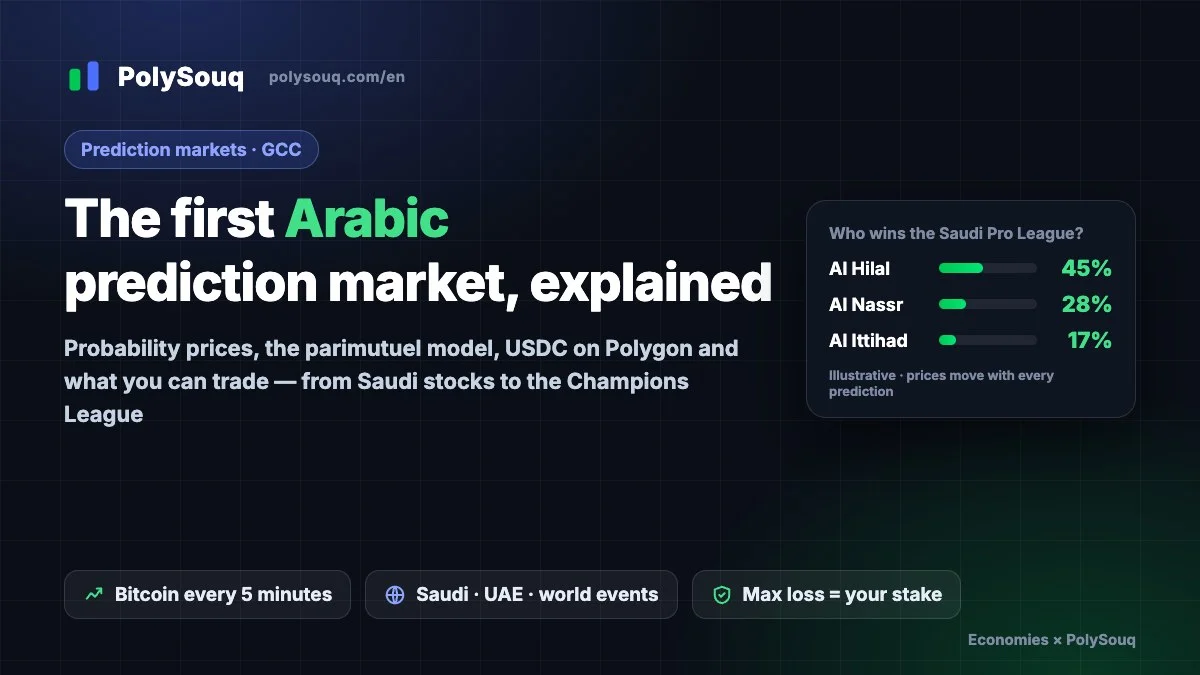
PolySouq is the first Arabic prediction market: an event trading platform where you buy YES or NO on Gulf and world events at a probability price, and the pool is settled by a parimutuel formula rather than against a house.
- Prices are probabilities: a YES quoted at 62 means the crowd currently puts a 62% chance on that outcome.
- Parimutuel, buy-only: winners split the losing side’s money minus a 10% commission taken only from the losing pot; your maximum loss is your stake.
- Full refund when nobody is wrong: if no one backed a losing answer, every stake goes back to the wallet.
- Funding is USDC on Polygon: $10 minimum deposit, $5 minimum withdrawal, no deposit fee, no monthly fee, no spread.
- The catalogue is regional: Saudi Pro League, Tadawul, UAE markets and real estate, GCC politics, plus the big European leagues, Bitcoin 5-minute windows, gold, oil and FX.
- Operated by a Cyprus-registered company; Arabic-first interface with a full English mirror at /en, KSA time and Gregorian dates.
What is a prediction market?
A prediction market turns a question about the future into a tradeable contract. “Will Al Hilal win the Saudi Pro League?” becomes a YES/NO market whose price moves between 0 and 100. Because a YES contract pays out only if the event happens, the price is a live estimate of probability: YES at 62 means the participants, with their own money at stake, collectively rate the chance at about 62%.
That is what separates event trading from an opinion poll: a poll asks what you think, a market asks what you will pay for being right, and prices sharpened by money at risk tend to beat pundits.
Most markets on PolySouq are multi-answer: three or more outcomes, such as every club that could win a league, each with its own probability price. PolySouq is one of the few prediction markets platforms built around Gulf and world events in Arabic.
Why did the GCC have no prediction market while the US exploded?
The last twelve months have been the category’s breakout year. According to the Pew Research Center (May 27, 2026), combined monthly global trading volume on Kalshi and Polymarket rose from under $5 billion in September 2025 to about $24 billion in April 2026 — more each month than US regulated sports-wagering operators averaged in 2025 (about $14 billion).
Inside the United States the regulated market is concentrated: CoinDesk (April 9, 2026) put Kalshi at about 89% of the CFTC-regulated segment. Polymarket remains mostly international — $1.3 billion of US volume against $9 billion internationally in April 2026, per Pew.
| Measure | Figure | Source |
|---|---|---|
| Kalshi + Polymarket monthly volume, Sept 2025 | Under $5 billion | Pew Research Center, May 2026 |
| Kalshi + Polymarket monthly volume, April 2026 | About $24 billion | Pew Research Center, May 2026 |
| US regulated sports-wagering operators, average monthly handle 2025 | About $14 billion | Pew Research Center, May 2026 |
| Kalshi share of the US CFTC-regulated market | About 89% | CoinDesk, April 2026 |
| Polymarket US vs International, April 2026 | $1.3 billion vs $9 billion | Pew Research Center, May 2026 |
| Arabic-language, GCC-focused platform before PolySouq | None | Economies research |
The gap for a Gulf reader is obvious. Both incumbents are English-only, priced around the US news cycle, and neither lists a Saudi Pro League fixture, a Tadawul IPO or a Dubai property milestone. Anyone in Riyadh, Dubai or Doha had no venue that spoke their language, ran on their clock or cared about their region. That is the space PolySouq fills: an Arabic-first prediction market for the GCC, with an English mirror for expats.
How does PolySouq’s parimutuel model work?
PolySouq never takes the other side of your position. Every event is a parimutuel pool. You buy YES or NO (or one answer in a multi-answer event) at the displayed probability price, and your stake joins the pool for that answer. When the event resolves, everyone who backed a correct answer shares all the money that was staked on incorrect answers, in proportion to their stake, after a 10% commission taken only from the losing pot. Winners always get their own stake back in full before the split.
Three consequences follow. There is no deposit fee, monthly fee or spread — the 10% on the losing side is the platform’s entire revenue. The platform is buy-only: a position is held until the event resolves. And your maximum loss is exactly what you staked.
| Answer | Money in pool | Displayed probability | Result | Returned per $1 staked |
|---|---|---|---|---|
| Al Hilal | $600 | 60 | Correct | $1.60 |
| Al Nassr | $300 | 30 | Incorrect | $0.00 |
| Al Ittihad | $100 | 10 | Incorrect | $0.00 |
| Losing pot | $400 | — | 10% commission = $40 | $360 distributed to winners |
Follow the arithmetic for one participant. Suppose you put $60 on Al Hilal. Your share of the winning pool is $60 / $600 = 10%. The losing pot is $300 + $100 = $400; the commission is 10% of $400 = $40; the $360 left is shared among Al Hilal backers. Your 10% share is $36. You receive your $60 back plus $36, a total of $96 — a 60% return, which is why the table shows $1.60 per $1. Had Al Nassr won instead, your $60 would be gone — the loss is capped at the stake.
The same formula produces a rule that surprises newcomers: if nobody backed a losing answer — you were the only participant, or everyone chose correctly — the losing pot is $0, so every stake is refunded in full. Voided markets are refunded in full as well.
Common error: the probability you see when you buy is not a locked-in price. In a parimutuel pool the final split depends on how the pool looks when the event closes, so a late rush of money onto your answer lowers everyone’s share of the losing pot. Treat the displayed number as the crowd’s current estimate, not a guaranteed payout.
What can you trade on PolySouq?
The catalogue mixes what an international reader already trades elsewhere with what nobody else lists: a 1X2 market per fixture across seven leagues, Up/Down windows on crypto and FX, and regional sections on the questions a Gulf resident actually argues about.
| Section | Typical markets | Open it |
|---|---|---|
| European football | 1X2 per fixture, outright winners | Champions League · Premier League · La Liga · Ligue 1 · Serie A · Bundesliga |
| Saudi Pro League | Every fixture, title race | Saudi Pro League |
| Saudi market | TASI levels, Tadawul IPOs, Aramco | Saudi Arabia |
| UAE | DFM and ADX events, Dubai property | UAE · Real estate |
| Politics and geopolitics | GCC and world decisions, summits, elections | Politics · GCC |
| Economics | OPEC decisions, rate moves, CPI prints | Economics |
| Crypto | Bitcoin and Ethereum 5-minute Up/Down; 4-hour, daily, weekly, monthly | 5-minute windows · All crypto |
| Forex and commodities | Gold (XAUUSD), oil (USOIL), EURUSD, USDJPY, silver Up/Down | Forex and commodities |
Entertainment, technology, health and culture round out the list. For readers who already trade gold or EURUSD, the Up/Down windows are the natural entry point: same instruments, but the only question is direction and the only capital at risk is the stake.
How do you open a PolySouq account?
Onboarding is six steps and takes a few minutes.
- Open the sign-up page. Go to polysouq.com/en/signup. The /en prefix keeps the whole interface in English; drop it for Arabic.
- Create the account with an email and password, or sign in with Google or Apple.
- Verify your email. Trading and commenting are locked until the confirmation link is clicked.
- Pick your interests. Choose leagues, markets and topics; PolySouq builds a personalised feed and a starter watchlist from them.
- Add funds. Open Portfolio, choose Add funds, copy your personal Polygon USDC address and send USDC from any wallet or exchange that supports the Polygon network. The minimum is $5.
- Pick an event and buy YES or NO. Start with something you already follow — a Premier League fixture or a gold Up/Down window — and size the stake as money you can afford to lose.
How do deposits and withdrawals work?
PolySouq runs on a single rail: USDC on the Polygon network, for both deposits and withdrawals. USDC is a dollar stablecoin, so your balance is shown in $ and does not move with crypto prices; Polygon settles transfers in seconds for a fraction of a cent. Minimum deposit $10, minimum withdrawal $5, no deposit fee. If you do not already hold USDC, buy it first and withdraw it on the Polygon network specifically — the same token exists on several chains, and only the Polygon version arrives.
Useful to know: the $10 deposit minimum and $5 withdrawal minimum mean you can test the whole loop — deposit, one small position, resolution, withdrawal — for a small amount. Send a small amount first if you have never used Polygon.
Friends, the accuracy leaderboard and the ideas feed
PolySouq’s pitch is “test your knowledge”, and the social layer is built around that. Every account has a personal invite link under Settings; friends who join can be challenged on the same events at /en/play, so a Premier League weekend becomes a head-to-head. The weekly accuracy leaderboard ranks users by how often they are right, not by how much they stake.
The parimutuel design has a friendly side effect here: if you take a position and no one takes the other side — your friend never accepts the challenge, say — there is no losing pot and your stake simply comes back.
Analysis lives at /en/ideas, a community feed with posts, replies, mentions, bookmarks and profiles, plus a comment thread under every event; a verified email is required to post. Longer explainers sit in the research section.
Transparency, values and who is behind PolySouq
Settlement is automated by consensus of public sources; anything uncertain goes to a human review queue rather than being forced. Every resolved market displays its outcome and source, and the leaderboard is public, so a sceptical reader can audit both the results and the people claiming to be good at this.
Two choices set PolySouq apart from the US platforms. It respects Arab culture and values: no events are listed that contradict them, and the product is framed as knowledge and analysis, not a game of chance. And the interface is Arabic-first — right-to-left, Saudi time, Gregorian dates — with the English mirror at /en for expats. The platform is operated by a Cyprus-registered company, and its Terms are governed by the laws of the Republic of Cyprus.
Asked why the region needed its own venue, Mike Brend, PolySouq’s Chief Marketing Officer, put it this way: “Someone in Jeddah knows more about the Saudi Pro League than any trader in New York, and someone in Dubai reads the property market better than any model built abroad. Prediction markets reward that knowledge — but only if the events, the language and the values are theirs. That is what we built.”
Is PolySouq a betting site?
No. Both involve money and an uncertain result, but the structure differs in every way that matters. A sportsbook or bookmaker sets the odds, takes the other side of every customer, builds its margin into the price and profits when customers lose. A prediction market such as PolySouq sets no odds — the participants do — never takes a position, earns only a disclosed commission on the losing pot, and covers markets, politics and economics as readily as football.
| Question | PolySouq (prediction market) | Sportsbook / betting site |
|---|---|---|
| Who sets the price? | The participants, through the pool | The operator’s odds desk |
| Who is on the other side? | Other users; the platform holds no position | The house |
| How does the operator earn? | 10% of the losing pot only, disclosed | Margin hidden inside the odds, plus customer losses |
| What does the price mean? | A probability, 0 to 100 | Decimal or fractional odds with a built-in overround |
| Scope of events | Sport, markets, politics, economics, crypto, culture | Mostly sport and casino-style games |
| What happens with no opponent? | Full refund of the stake | Not applicable — the house always accepts |
| Framing | Test your knowledge; public accuracy ranking | Gambling; promotions and bonuses |
The last row matters most. A betting site is built to keep you playing; a prediction market is built to find out who is right. That is why PolySouq reads as a Polymarket alternative for the Middle East rather than anything in the gambling category.
Test your knowledge on the events you actually follow
Email, Google or Apple sign-in, a $10 minimum deposit, and a catalogue built for the Gulf. Your maximum loss is always the amount you stake.
Open your PolySouq accountReal money. Funding is USDC on Polygon only. You can lose the full amount you stake.
Related reading
- PolySouq research hub — explainers on how prediction markets price events.
- PolySouq FAQ — the platform’s own answers on accounts, funding and settlement.
- Responsible trading — limits, self-control tools and the risk framework.
Disclosure and notes. Prepared by the Economies editorial team; contains links to PolySouq, a partner platform. Product facts (commission, minimums, funding rail, catalogue) were verified on 2026-09-05 and may change. US market figures are from the Pew Research Center (May 27, 2026) and CoinDesk (April 9, 2026). Event trading carries the risk of losing your entire stake; nothing here is investment advice. Check the rules in your country of residence before opening an account.
Frequently asked questions
What is PolySouq?
PolySouq is the first Arabic prediction market, an event trading platform covering GCC and world events. Users buy YES or NO on an outcome at a probability price between 0 and 100, and each market settles as a parimutuel pool. It is Arabic-first with an English mirror at polysouq.com/en, operated by a Cyprus-registered company.
How does PolySouq make money?
PolySouq charges a 10% commission taken only from the money staked on incorrect answers when a market resolves. The remaining 90% of the losing pot is distributed to users who backed the correct answer, in proportion to their stakes. There is no deposit fee, no monthly fee and no spread, and the platform never takes a position against its users.
What is the maximum I can lose on a PolySouq market?
The amount you staked on that market, and never more. If the answer you backed is wrong, your stake goes into the losing pot and is distributed to the users who were right. There is no leverage, no margin call and no negative balance, so a $20 position can cost you at most $20.
What happens if nobody takes the other side of my position?
You get your stake back in full. PolySouq is parimutuel, so winners are paid from the money staked on losing answers; if nobody backed a losing answer, whether because you were the only participant or everyone chose correctly, the losing pot is empty, no commission is charged and every stake is refunded to the wallet.
How do I deposit money into PolySouq?
Deposits are made in USDC on the Polygon network only. In your Portfolio, choose Add funds, copy your personal Polygon USDC address and send USDC from any wallet or exchange that supports Polygon. The minimum deposit is $10, there is no deposit fee, and the balance is displayed in dollars. The minimum withdrawal is also $5.
Can I change or cancel a position before the event resolves?
No. PolySouq is buy-only: once you buy YES or NO, the stake stays in the pool until the market resolves and is then either paid out or lost. This is part of the parimutuel design, so decide your stake before you commit and only use money you can leave in the market until resolution.
Which events can I trade on PolySouq?
Football across the Champions League, Premier League, La Liga, Ligue 1, Serie A, Bundesliga and Saudi Pro League; Saudi market events including Tadawul IPOs and Aramco; UAE markets and Dubai real estate; politics, geopolitics and economics; Bitcoin and Ethereum 5-minute Up/Down windows; and gold, oil, EURUSD, USDJPY and silver. Most events have three or more possible answers.
How are PolySouq markets settled?
Settlement is automated by consensus of public sources, and any case the automation cannot resolve with confidence goes to a human review queue. Every resolved market shows its final outcome and the source it was settled on, and the accuracy leaderboard is public. Voided markets are refunded in full.