


 |
Gold posts strong gains... has its resurgence begun?

The precious metal has returned to the spotlight across global financial markets after recording its biggest weekly gain since January last week.
The powerful rally was fueled by strong investment momentum and heavy demand for bullion, raising a crucial question across financial markets: Are we witnessing the beginning of a sustained resurgence in gold, or is this merely a temporary rally?
To answer this important question, we examine the economic drivers and fundamental forces that have given gold its latest momentum and propelled prices to their highest levels in nearly two months.
First: Easing geopolitical tensions and improving liquidity conditions
The relative easing of geopolitical tensions in the Middle East has calmed market fears and brought an end to the wave of "forced selling" that had previously emerged as investors scrambled to raise cash.
This improvement has supported investor sentiment and helped normalize capital flows, encouraging renewed investment demand for bullion and the building of longer-term positions in a more stable trading environment.
Second: Lower expectations for US interest-rate hikes
The sharp decline in expectations for US interest-rate hikes this year has provided another major boost to gold prices.
The shift in market expectations followed a series of bleak and disappointing US labor-market reports that showed a significant slowdown in job creation, alongside easing concerns over inflationary pressures.
These weaker signals forced investors to reassess the Federal Reserve's monetary-policy outlook and increased bets that the economy is moving closer to a monetary-easing cycle. That directly reduced the opportunity cost of holding non-yielding gold, making the metal more attractive as investors reallocated capital.
Third: Positive flows return to gold ETFs
Gold exchange-traded funds have witnessed a significant reversal in flows, shifting from persistent outflows to renewed inflows and stronger buying activity.
This shift is an important indicator of renewed interest from major institutional investors and portfolio managers seeking to build longer-term positions in the precious metal. These flows have provided a stronger liquidity base and meaningful support for the latest price rally, while improving confidence in the market.
Fourth: SPDR Gold Trust holdings jump sharply
Reflecting this resurgence in institutional demand, holdings at SPDR Gold Trust, the world's largest gold-backed exchange-traded fund, have recorded a sustained increase since July 17.
Total holdings climbed from 999.02 metric tons to 1,020.96 metric tons by August 10, reaching their highest level in nearly two months.
The accumulation of around 21.94 metric tons within just a few weeks reflects growing conviction among large investors and institutions in gold's bullish outlook, providing a solid foundation that could help sustain the metal's recent gains.
Fifth: Bullish forecasts from major global banks and financial institutions
Major global financial institutions and investment banks broadly expect gold's upward trajectory to continue, with leading Wall Street analysts increasingly viewing the metal as a strategic asset within investment portfolios.
• Goldman Sachs and UBS: The two banks expect a relatively balanced advance toward $4,900-$5,500 an ounce, with lower opportunity costs and renewed investment-fund inflows expected to remain key drivers of further gains.
• Bank of America and Citibank: Both see gold potentially reaching $6,000 an ounce, viewing the metal as a three-dimensional hedge against inflation, geopolitical risks and rising global sovereign debt.
• JPMorgan: The bank adopts one of the most bullish scenarios, expecting prices to potentially reach unprecedented levels of around $6,000-$6,300 an ounce, supported by accelerating central-bank purchases and the continued trend toward reducing dependence on the US dollar.
Technical analysis: Falling-wedge breakout restores bullish momentum
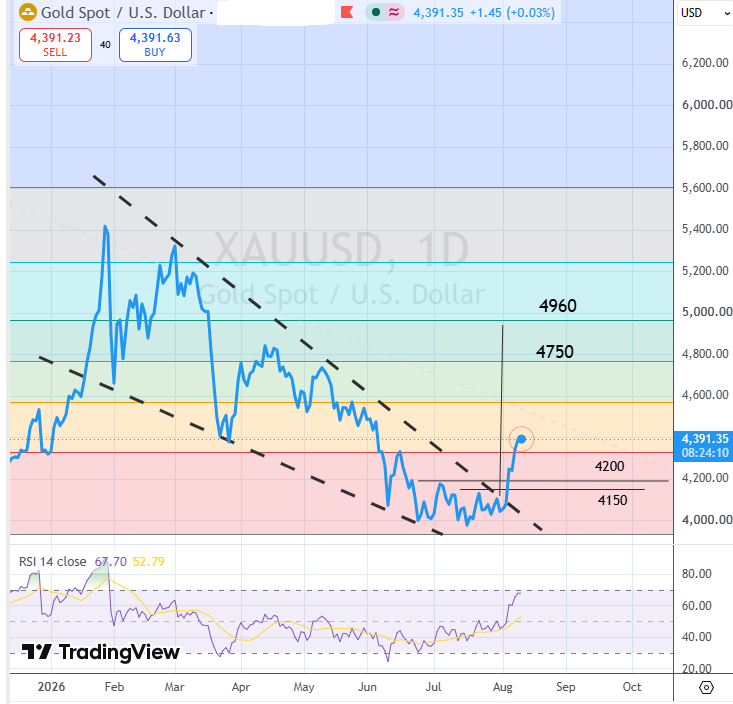
From a technical perspective, gold's daily chart has shown a clear positive shift in price behavior after the precious metal broke out of a "falling wedge" pattern last week, one of the most prominent reversal formations typically associated with fading selling pressure and the potential beginning of a new bullish cycle.
With prices continuing to trade above the breakout area around $4,200, gold is currently maintaining an upward trajectory over the short and medium term, supported by a rising Relative Strength Index that reflects strong buying momentum without yet reaching extreme overbought territory.
Key price targets and support levels
Upside targets:
• First target: $4,750, representing the first major resistance level on the daily timeframe.
• Second target: $4,960, a key corrective level that could open the door to a retest of record highs.
Support levels and trend protection:
A daily close above the upper boundary of the broken wedge around $4,200-$4,150 remains essential to maintaining the bullish scenario. This area represents the first line of defense and a key level for preserving the current corrective upward trend.
Thanks for your feedback.
Oil extends gains as hopes for Strait of Hormuz agreement fade

Oil prices rose on Tuesday as disruptions to Middle Eastern energy flows continued and hopes faded for an agreement between the United States and Iran that would reopen the Strait of Hormuz and restore freedom of navigation.
MoreDollar holds firm ahead of US inflation data

The US dollar held largely steady against most major currencies on Tuesday as investors monitored geopolitical developments in the Middle East while awaiting key US inflation data.
MoreGold retreats from 10-week high on Strait of Hormuz developments

Gold prices fell in European trading on Tuesday for the first time in three days, retreating from a 10-week high reached earlier in the Asian session, as correction and profit-taking gathered pace alongside pressure from a stronger dollar and rising oil prices as hopes faded for an agreement between the United States and Iran over the Strait of Hormuz.
More