


 |
Fed Says No Cuts Until 2028: How to Trade It with Pepperstone
Risk warning: CFDs are complex instruments and come with a high risk of losing money rapidly due to leverage. This article describes a disagreement between the Federal Reserve and the market. Disagreements of this kind can persist far longer than a leveraged position can survive. Nothing here is a recommendation to buy or sell anything.
The short answer
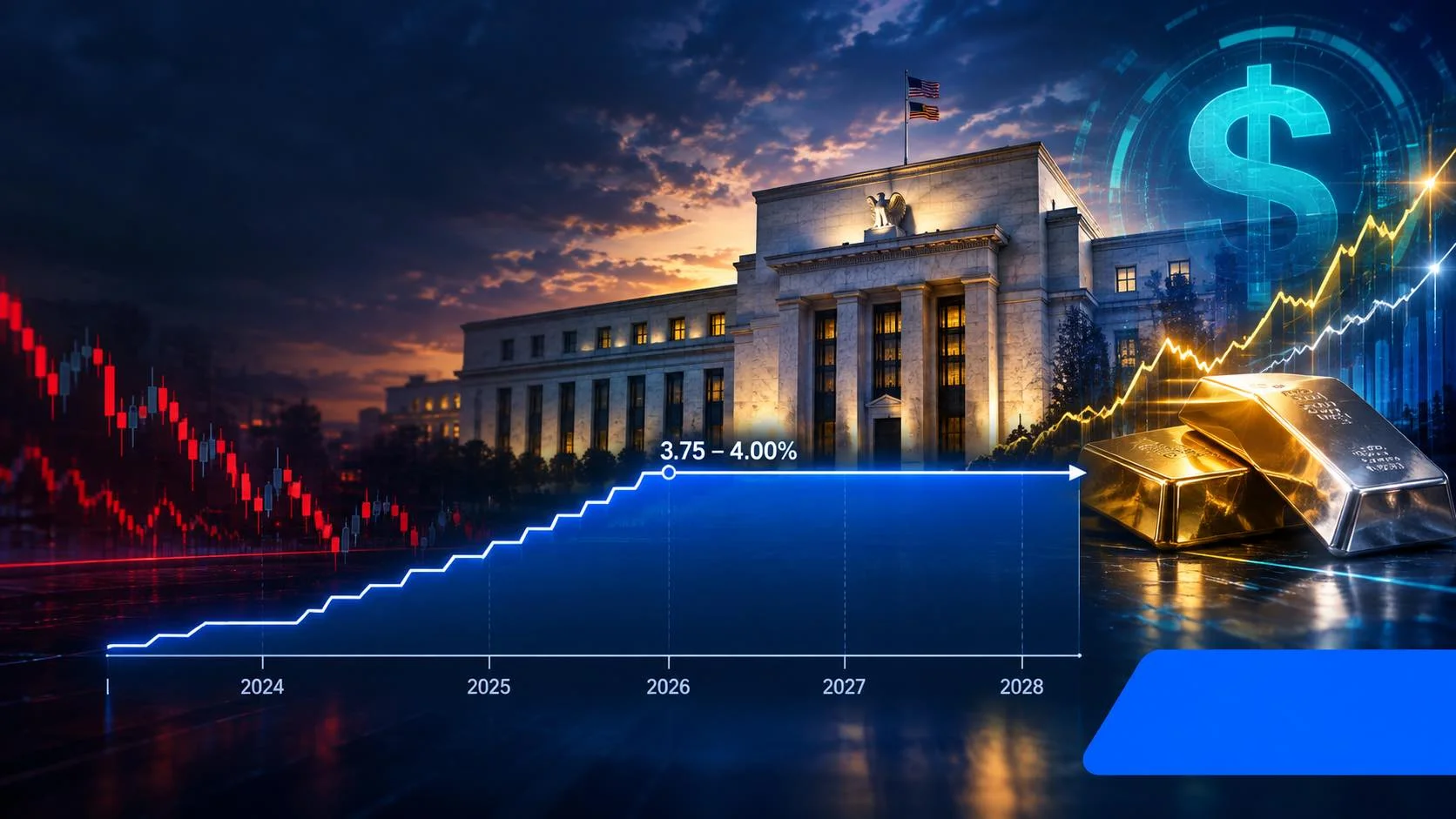
On Wednesday the Federal Reserve raised rates to 3.75%–4.00% on a unanimous 12–0 vote — the first US hike since 2023. But the decision was 93% priced and carried no information. The information was in the dot plot, and it said something the market has spent the last three sessions refusing to believe.
- The 2027 median is 4.1% — identical to 2026. The Fed is projecting zero cuts through all of 2027, against 3.6% in the June projections.
- That is a 50 basis point hawkish shift in 2027, 2028 and 2029 simultaneously.
- The Fed does not expect 2% inflation until 2029. Its own chair was asked about the contradiction and said the forecasts were not his.
- Warsh refused to call 4% restrictive: “we removed a dose of accommodation.” That is the hawkish tell, not the hike.
- Markets fell hard on Wednesday and reversed the entire move by Thursday’s close. Gold and silver went up through a hawkish hike against a rising dollar.
What the Fed actually did
| Item | Detail |
|---|---|
| New target range | 3.75% – 4.00%, effective 17 September |
| Vote | 12–0, unanimous — no dissents |
| Interest on reserve balances | 3.90% |
| Primary credit rate | 4.00% |
| Bank prime rate | 6.75% → 7.00% |
| Balance sheet | Reinvestment continues — “maintaining ample reserves” |
Two details are worth pausing on. First, the vote was unanimous — the July meeting had three dissents in favour of hiking, and this time nobody dissented in either direction. Second, the statement was unusually short: three short paragraphs, no forward guidance, none of the usual “the Committee will continue to monitor” language. A committee that has stopped explaining itself is a committee that expects to act again.
The dot plot is the story, and it is worse than the headline
Every quarter the FOMC publishes its members’ own projections for where rates should be. Here is what changed between June and September:
| Median projected fed funds rate | 2026 | 2027 | 2028 | 2029 | Longer run |
|---|---|---|---|---|---|
| September 2026 | 4.1 | 4.1 | 3.9 | 3.6 | 3.2 |
| June 2026 | 3.8 | 3.6 | 3.4 | 3.1 | — |
| Change | +0.3 | +0.5 | +0.5 | +0.5 | — |
Read the 2026 and 2027 columns together, because that is where the shock is. The median participant sees rates at 4.1% at the end of 2026 and still 4.1% at the end of 2027. The first number implies one more hike this year. The second implies not a single cut in the whole of 2027. In June, the same committee was projecting 3.6% for 2027. That is half a percentage point of expected easing deleted in one quarter.
The inflation projections explain why. The median participant does not expect PCE inflation back at the 2% target until 2029 — and revised 2026 core PCE up to 3.4%. Unemployment was revised down to 4.1% for both 2026 and 2027, removing the labour-market argument for patience.
The line that actually moved the market
Asked whether policy is now restrictive, the chair declined to say it is. “I would be hard-pressed to describe broad financial conditions as restrictive. This view was widely shared by the Committee. So we removed a dose of accommodation.”
That sentence is the whole meeting. “Removing accommodation” is not the same as tightening. It means the Fed believes 4% is still stimulative — that it has not yet reached neutral, let alone restrictive. If you accept that framing, the one-and-done trade is dead, and the 4.1% dot for 2026 stops looking like a forecast and starts looking like a floor.
He was equally blunt on his own role. “I’m not in the forward guidance business… I’m ill-prepared to pre-judge those future actions.” And on data: “I’m not a data point dependent guy. Data point dependence is a dangerous preoccupation.”
One oddity worth knowing: the chair did not submit a projection of his own, as he also declined to in June. When a reporter pointed out that the projections push 2% inflation to 2029 while the statement promises a timelier return, he replied that those are not his forecasts. So the dot plot that moved markets does not contain the view of the person who runs the committee.
Then the market stopped listening — in about 24 hours
This is the part that makes today interesting rather than merely historical.
| Session | What happened |
|---|---|
| Wed 16 Sep | Decision day. Dow −600 points (−1.2%), S&P 500 −0.5%, 2-year to 4.74%, 10-year through 5% |
| Thu 17 Sep | Full reversal. Best equity day in six weeks — S&P +1.1%, Nasdaq 100 +1.7%. 10-year −7bp to 4.94%, snapping an eight-session rising streak |
| Fri 18 Sep | Drift. S&P 7,650.50 (+0.17%), 10-year back to 4.998%, VIX 14.81, DXY 100.215 (+1.1% on the week) |
So we now have a standoff. The Federal Reserve has published, in its own numbers, a path with one more hike this year and no cuts at all next year. Equity markets took one day to price that and then unwound the entire move. One of the two is wrong, and the resolution is what you are actually trading. The bond market has not fully unwound — the 10-year is back at 5% — which suggests credit believes the Fed and equity does not.
The anomaly: gold and silver rose through a hawkish hike
Textbook says higher rates hurt metals that pay no yield, and a stronger dollar hurts them again. Last week delivered both, and both metals went up anyway.
| Metal | Friday close | Week | Year-on-year | 50-day | 200-day | RSI |
|---|---|---|---|---|---|---|
| Gold | $4,380.01 | +0.73% | +33% | $4,381.74 | $4,475.45 | 44.2 |
| Silver | $66.35 | +3.05% | +73% | $64.93 | $69.94 | 50.7 |
Silver outpaced gold roughly four to one on the week, and both rose while the dollar index gained 1.1%. Metals bought against a rising dollar are being bought on their own merits rather than as a currency hedge — which is a different and more durable kind of bid.
But read the last three columns before you get excited. Both metals are still trading below their 200-day moving averages despite gold up 33% and silver up 73% year-on-year. Silver’s RSI is 50.7 — dead neutral. This is a market consolidating after a very large move, not one breaking out. And there is a second tell: while silver rose 3% on the week, the silver miners ETF fell 1.20% and the gold miners ETF fell 1.67%. When the metal rips and the miners do not follow, the equity market is telling you it does not believe the price will hold.
Two central banks moved last week. Positions are being rebuilt now
Pepperstone offers MT4, MT5, cTrader and TradingView with published, dated average spreads, a 2.5% disclosed financing mark-up on index and commodity CFDs, and no minimum deposit. Test the platform on a free demo before you commit capital to a contested macro view.
Open a free demo accountPepperstone is regulated by the FCA (684312), ASIC (AFSL 414530), CySEC (388/20), BaFin (151148) and the DFSA (F004356)
CFDs are complex instruments and come with a high risk of losing money rapidly due to leverage. 79.6% of retail investor accounts lose money when trading CFDs with this provider (Pepperstone Markets Limited — Bahamas entity). You should consider whether you can afford to take the high risk of losing your money.
How can you trade this with Pepperstone?
To be explicit: the analysis above is our editorial team’s, not Pepperstone’s. What follows is which instruments carry this disagreement and what would confirm or break each side of it.
| If you think... | The instruments | What confirms it |
|---|---|---|
| The Fed means it — no cuts in 2027 | USD long, EUR/USD short, 2-year yields higher | October hike priced above 60%; 10-year holding 5% |
| The market is right and the Fed blinks | Nasdaq 100, S&P 500 index CFDs, gold | A soft payrolls or CPI print; 10-year back below 4.80% |
| The metals bid is real | XAU/USD, XAG/USD | Both reclaiming their 200-day averages; miners finally following |
| The metals bid is exhaustion | Short exposure, or simply standing aside | Silver failing at $69.94; miners continuing to lag |
| Energy re-ignites the inflation problem | Brent, WTI, USD/CAD | OPEC+ on 4 October; any second strike on Saudi infrastructure |
Three practical points for a contested macro view. This is a slow trade, not an event trade — the next FOMC is 28 October, so financing costs matter far more than they did last week. Check the overnight charge before you hold anything for weeks; Pepperstone publishes a 2.5% mark-up on index, commodity and share CFDs, which is more than most competitors disclose at all. And the entity you are onboarded to sets your leverage cap — FCA, ASIC, CySEC, BaFin and DFSA all cap retail differently.
What else moved, and what to watch
| Market | Level, Friday 18 September | Note |
|---|---|---|
| Brent crude | $103.87 | Down from above $108 on 14 September as Saudi repairs came in faster than feared — still +55.8% y/y |
| USD/JPY | ~157 | The Bank of Japan hiked to 1.25%, its highest since 1995 — and the yen fell |
| Bitcoin | >$81,000 | Up from about $77,700 a week earlier, despite its market-structure bill failing a Senate cloture vote on 15 September |
| VIX | 14.81 | Complacent, given an unresolved Fed-versus-market standoff |
The Bank of Japan move deserves a line of its own because it rhymes with the Fed story. A central bank raised rates to a 31-year high and its currency weakened — because the market read the accompanying signal as dovish. Policy decisions are not the trade. What the committee says about the next one is the trade.
Watching two policy paths at once
FX, indices, metals and energy all sit in the same account. Pepperstone publishes dated average spreads rather than a best-ever minimum — useful when you are pricing a position you intend to hold through an October meeting.
Open a free demo accountPepperstone is regulated by the FCA (684312), ASIC (AFSL 414530), CySEC (388/20), BaFin (151148) and the DFSA (F004356)
CFDs are complex instruments and come with a high risk of losing money rapidly due to leverage. 79.6% of retail investor accounts lose money when trading CFDs with this provider (Pepperstone Markets Limited — Bahamas entity). You should consider whether you can afford to take the high risk of losing your money.
Related reading
- Economic calendar — The October meeting and the data before it.
- Best trading brokers — Compare regulated brokers by market.
- Best demo accounts — Test a platform before committing capital.
Risk warning and disclosure. General market commentary published 21 September 2026, not personal investment advice, and it does not take account of your objectives or circumstances. CFDs are complex instruments and come with a high risk of losing money rapidly due to leverage; 79.6% of retail investor accounts lose money when trading CFDs with Pepperstone Markets Limited (Bahamas entity). Loss rates differ by regulated entity. FOMC figures are from the Federal Reserve’s own statement, implementation note, Summary of Economic Projections and preliminary press-conference transcript of 16 September 2026; the transcript is marked preliminary and may be revised. Treasury yields are from the Federal Reserve H.15 series. Market levels are Friday 18 September closes and will have changed. Past performance does not indicate future results. Verify all figures with primary sources before acting.
Frequently asked questions
What did the Fed do on 16 September 2026?
Raised the target range 25 basis points to 3.75%–4.00% on a unanimous 12–0 vote — the first US rate rise since 2023. Interest on reserve balances went to 3.90% and the bank prime rate moved from 6.75% to 7.00%, effective 17 September.
What does the new dot plot show?
The median participant projects the fed funds rate at 4.1% at the end of 2026 and 4.1% at the end of 2027. The first implies one more hike this year; the second implies no cuts at all during 2027. In June the same committee projected 3.6% for 2027, so this is a 50 basis point hawkish revision — repeated across 2028 and 2029.
Why did markets go up if the Fed was hawkish?
They went down first. The Dow fell more than 600 points on decision day and the 10-year traded through 5%. Then on Thursday the entire move reversed in the best equity session in six weeks. The honest answer is that equity markets do not believe the projections — bond markets, with the 10-year back near 5%, appear to believe them rather more.
When is the next Fed meeting?
28 October 2026. It is not a projections meeting, so there will be no new dot plot — just the decision and the press conference. That makes the intervening CPI and payrolls releases unusually important, because they are the only new information the committee will have.
Why are gold and silver rising if rates are rising?
That is the week’s genuine anomaly. Both rose against a dollar index that gained 1.1%, which means they were bought on their own merits rather than as a currency hedge. But both remain below their 200-day moving averages and the mining shares fell while the metals rose — a divergence that usually signals the equity market doubts the move will hold.
Is silver a better buy than gold right now?
Silver rose roughly four times as fast as gold last week and is up 73% year-on-year against gold’s 33%. It is also far more industrial, which makes it a cyclical bet dressed as a monetary one — and the Fed has just told you it intends to slow the cycle. Silver’s RSI at 50.7 is neutral, not oversold and not overbought.
What does “removing accommodation” mean?
It means the Fed thinks policy was stimulative and is now slightly less so — not that policy is restrictive. The chair explicitly declined to describe conditions as restrictive and said the Committee broadly shared that view. If 4% is not yet tight, the 4.1% dot is a floor rather than a ceiling.
Should I trade this or wait?
This is a slow disagreement, not a single event, and it may take months to resolve. Financing costs matter far more than they did last week — a leveraged position held for weeks pays an overnight charge every night. Many traders will reasonably conclude that the clearest expression of this view is a smaller position held longer, or none at all until October.